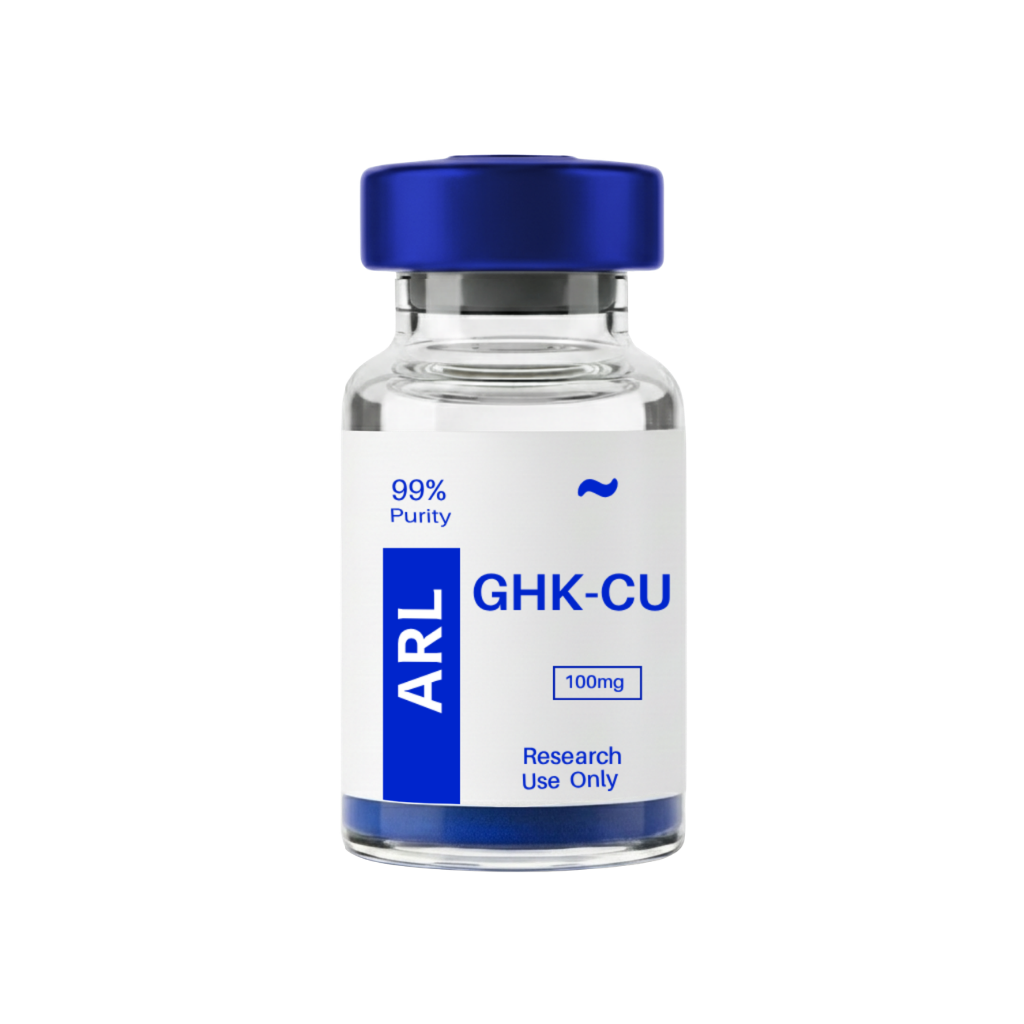
GHK-Cu
GHK-Cu
This batch of GHK-Cu Copper Peptide has been third party lab tested and verified for quality.
Contents: GHK-Cu (Copper Peptide)
Form: Powder
Purity: 99.2%
Couldn't load pickup availability
Free Reconstitution Solution automatically added to your cart with each order.
This product is Made, Tested & Shipped From Canada.
Ships Today
Order by 1:00 PM EST
Free Shipping
For 2 or more vials
Verified+

GHK-Cu
GHK-Cu is a naturally occurring copper-complexed tripeptide originally identified in human blood plasma and later detected in saliva and urine. Scientific literature describes GHK-Cu as a biologically active peptide involved in cellular signaling pathways that contribute to tissue integrity and immune regulation. Research investigations have explored its influence on oxidative balance, protein synthesis modulation, antimicrobial defense, and connective tissue organization.
Experimental evidence indicates that GHK-Cu participates in biological processes associated with wound repair and skin cell biology. Laboratory studies demonstrate that the peptide influences fibroblast function, extracellular matrix remodeling, and coordinated cellular responses under controlled research conditions.
GHK-Cu Structure
GHK-Cu consists of the tripeptide sequence glycine-histidine-lysine bound to a copper ion. This molecular configuration enables interactions with cellular receptors and extracellular matrix components that influence downstream biological activity observed in experimental systems.
GHK-Cu Research
1. GHK-Cu and Skin Repair Processes
As a naturally occurring peptide within human biological systems, GHK-Cu contributes to mechanisms involved in skin regeneration. In vitro studies demonstrate that the peptide regulates synthesis and degradation of collagen, glycosaminoglycans, proteoglycans, and chondroitin sulfate. These actions are associated with recruitment of fibroblasts, endothelial cells, and immune cells to sites of tissue injury.
Research observations associate GHK-Cu with improvements in skin elasticity and firmness. Additional findings include reductions in markers related to photodamage, pigmentation imbalance, and surface irregularities. Collagen modulation supports organized tissue remodeling and controlled scar formation through transforming growth factor-β signaling and gene transcription regulation.
Animal research indicates that GHK-Cu increases healing rates following burn injury by promoting angiogenesis. Because blood vessel regrowth is often impaired in burn wounds, these findings support its relevance in experimental wound healing research.
2. GHK-Cu and Antimicrobial Activity
Microbial contamination is a major contributor to delayed wound healing. Laboratory studies show that GHK-Cu, particularly when combined with selected fatty acids, exhibits antimicrobial activity against organisms associated with chronic wound environments.
Research involving diabetic wound models demonstrates improved wound closure and reduced infection rates under experimental conditions. Tissue analysis indicates enhanced cellular organization and overall tissue quality.
3. GHK-Cu and Nervous System Research
Age-related neuronal decline remains an area of scientific interest. Preclinical studies suggest that GHK-Cu supports neural tissue by enhancing angiogenesis, increasing nerve growth factor expression, and modulating anxiety-related behavior in animal models. Evidence also indicates effects on gene expression relevant to nervous system maintenance.
GHK-Cu is present at relatively high levels in brain tissue, though concentrations decline with age. Research suggests that reduced levels may contribute to increased susceptibility to neurodegeneration. In rodent stroke models, GHK-Cu administration reduced neuronal apoptosis through pathways involving miR-339-5p and VEGFA.
4. GHK-Cu and Chemotherapy-Related Tissue Effects
Animal studies indicate that GHK-Cu mitigates lung fibrosis induced by chemotherapeutic agents such as bleomycin. These effects involve suppression of inflammatory signaling and regulation of cytokines including TNF-α and IL-6.
Similar protective outcomes have been observed in experimental models of acute respiratory distress syndrome, suggesting relevance for inflammation-focused research.
5. GHK-Cu and Pain-Related Studies
In controlled animal studies, GHK-Cu demonstrated dose-dependent effects on pain-associated behaviors. Proposed mechanisms include peripheral analgesic activity and interactions with L-arginine signaling pathways.
GHK-Cu has shown minimal adverse effects and favorable bioavailability in animal studies. This material is supplied exclusively for scientific and educational research and is not approved for human or veterinary use.
Authorship and Scientific Attribution
This document is based on literature reviewed by Dr. Logan, M.D., a graduate of Case Western Reserve University School of Medicine with formal training in molecular biology.
Dr. Loren Pickart, Ph.D., is cited for his extensive peer-reviewed research on GHK-Cu. Citation is provided solely for academic acknowledgment and does not imply endorsement, affiliation, or commercial relationship.
References
- L. Pickart, J. M. Vasquez-Soltero, and A. Margulies, "GHK Peptide as a Natural Modulator of Multiple Cellular Pathways in Skin Regeneration," BioMed Res. Int., vol. 2015, p. 648108, 2015. [BioMed Research International]
- A. Gruchlik, E. Chodurek, and Z. Dzierzewicz, "Effect of GLY-HIS-LYS and its copper complex on TGF-β secretion in normal human dermal fibroblasts," Acta Pol. Pharm., vol. 71, no. 6, pp. 954-958, Dec. 2014. [PubMed]
- L. Pickart and A. Margulies, "Regenerative and Protective Actions of the GHK-Cu Peptide in the Light of the New Gene Data," Int. J. Mol. Sci., vol. 19, no. 7, Jul. 2018. [PubMed]
- X. Wang et al., "GHK-Cu liposomes accelerate scald wound healing in mice by promoting cell proliferation and angiogenesis," Wound Repair Regen. Off. Publ. Wound Heal. Soc. Eur. Tissue Repair Soc., vol. 25, no. 2, pp. 270–278, 2017. [PubMed]
- M. Kulawska, M. Kulawska-Kaczuka, and K. Dzerdzinska, "In vitro studies of antimicrobial activity of Gly-His-Lys conjugates as potential and promising candidates for therapeutics in skin and tissue infections," Bioorg. Med. Chem. Lett., vol. 25, no. 3, pp. 542–546, Feb. 2015. [Science Direct]
- G. D. Mulder et al., "Enhanced healing of ulcers in patients with diabetes by topical treatment with glycyl-l-histidyl-l-lysine copper," Wound Repair Regen. Off. Publ. Wound Heal. Soc. Eur. Tissue Repair Soc., vol. 2, no. 4, pp. 259–269, Oct. 1994. [PubMed]
- S. O. Canapp et al., "The effect of topical tripeptide-copper complex on healing of ischemic open wounds," Vet. Surg. VS, vol. 32, no. 6, pp. 515–523, Dec. 2003. [PubMed]
- L. Pickart, J. M. Vasquez-Soltero, and A. Margulies, "The Effect of the Human Peptide GHK on Gene Expression Relevant to Nervous System Function and Cognitive Decline," Brain Sci., vol. 7, no. 2, Feb. 2017. [PubMed]
- H. Zhang, Y. Wang, and Z. He, "Glycine-Histidine-Lysine (GHK) Alleviates Neuronal Apoptosis Due to Intracerebral Hemorrhage via the miR-339-5p/VEGFA Pathway," Neuropsychiatric Dis. Treat., vol. 12, p. 644, 2018. [PubMed]
- X. M. Zhou et al., "GHK Peptide Inhibits Bleomycin-Induced Pulmonary Fibrosis in Mice by Suppressing TGFβ1/Smad-Mediated Epithelial-to-Mesenchymal Transition," Front. Pharmacol., vol. 8, p. 904, Dec. 2017. [PubMed]
- J.-R. Park, H. Lee, S.-I. Kim, and S.-R. Yang, "The tri-peptide GHK-Cu complex ameliorates lipopolysaccharide-induced acute lung injury in mice," Oncotarget, vol. 7, no. 35, pp. 58405–58417, Sep. 2016. [PubMed]
- L. A. Senel-yanova and M. E. Delighiaey, "Effects of Tripeptide Gly His Lys in Pain-Induced Aggressive-Defensive Behavior in Rats," Bull. Exp. Biol. Med., vol. 164, no. 2, pp. 140–143, Dec. 2017. [Springer]
- L. A. Senel-yanova and D. V. Proshiov, "Binding of Oligopeptides to L-Arginine Inverts Its Analgesic and Antiepyogenic Effects," Bull. Exp. Biol. Med., vol. 165, no. 5, pp. 621–624, Sep. 2018. [PubMed]
-
check_circle
HIGHEST QUALITY PEPTIDES
Our products are scientifically formulated and manufactured in cGMP-compliant facilities.
-
encrypted
FAST DELIVERY
Enjoy fast and reliable 3–5 day shipping.
-
check_circle
Dedicated Customer Service
Our customer service team is highly knowledgeable in peptide research and its applications. We’re available 24/7 to assist you.
Verified reviews
Tested. Verified. Trusted.
We take a laboratory-first approach to quality. Each batch is made under controlled conditions and verified by an independent lab (HPLC/MS). We only ship batches that test ≥99% purity, and we provide a full COA, including identity, methods, and chromatograms, for your review.
You may also like
-
Ipamorelin Growth Hormone Peptide - Research Grade Peptide
Regular price From $32.00Regular price From $32.00 Sale priceUnit price / per$42.0023% -
SAVE 25%Reconstitution Solution
Regular price $15.00Regular price $15.00 Sale priceUnit price / per$20.0025% -
Sermorelin - Premium Research Peptide
Regular price From $70.00Regular price From $70.00 Sale priceUnit price / per$92.0023% -
SAVE 25%Gonadorelin
Regular price $50.00Regular price $50.00 Sale priceUnit price / per$67.0025% -
SAVE 23%SLU-PP-332
Regular price $125.00Regular price $125.00 Sale priceUnit price / per$164.0023% -
SAVE 25%Tirzepatide
Regular price From $50.00Regular price From $50.00 Sale priceUnit price / per$67.0025% -
SAVE 23%Semaglutide
Regular price From $36.00Regular price From $36.00 Sale priceUnit price / per$47.0023% -
SAVE 23%CJC-1295 No DAC & Ipamorelin
Regular price $95.00Regular price $95.00 Sale priceUnit price / per$124.0023% -
SAVE 23%5-Amino-1MQ
Regular price $80.00Regular price $80.00 Sale priceUnit price / per$105.0023% -
SAVE 23%BPC-157 + TB-500 + GHK-Cu
Regular price $155.00Regular price $155.00 Sale priceUnit price / per$202.0023% -
SAVE 23%L-Carnitine
Regular price $97.00Regular price $97.00 Sale priceUnit price / per$127.0023% -
CJC-1295 (No DAC) - Premium Research Peptide
Regular price From $75.00Regular price From $75.00 Sale priceUnit price / per$98.0023% -
SAVE 23%Kisspeptin-10
Regular price From $65.00Regular price From $65.00 Sale priceUnit price / per$85.0023% -
SAVE 23%CJC-1295 with DAC
Regular price $139.00Regular price $139.00 Sale priceUnit price / per$182.0023% -
SAVE 24%KPV Tripeptide
Regular price From $56.00Regular price From $56.00 Sale priceUnit price / per$74.0024% -
SAVE 24%Thymosin Alpha-1
Regular price From $79.00Regular price From $79.00 Sale priceUnit price / per$104.0024% -
SAVE 25%Epitalon (Epithalon)
Regular price From $50.00Regular price From $50.00 Sale priceUnit price / per$67.0025% -
Ipamorelin - Premium Research Peptide
Regular price From $32.00Regular price From $32.00 Sale priceUnit price / per$42.0023% -
SAVE 23%Tesamorelin
Regular price From $80.00Regular price From $80.00 Sale priceUnit price / per$105.0023% -
SAVE 23%GHRP-6 - Premium Research Peptide
Regular price From $29.00Regular price From $29.00 Sale priceUnit price / per$38.0023% -
SAVE 25%Melanotan II (MT2)
Regular price $50.00Regular price $50.00 Sale priceUnit price / per$67.0025% -
SAVE 23%Retatrutide Triple Agonist
Regular price From $90.00Regular price From $90.00 Sale priceUnit price / per$118.0023% -
SAVE 24%IGF-1 LR3 (Long R3)
Regular price From $40.00Regular price From $40.00 Sale priceUnit price / per$53.0024% -
SAVE 23%BPC-157 + TB-500
Regular price From $97.00Regular price From $97.00 Sale priceUnit price / per$127.0023% -
SAVE 24%Dermorphin
Regular price $56.00Regular price $56.00 Sale priceUnit price / per$74.0024% -
SAVE 23%Glutathione
Regular price $83.00Regular price $83.00 Sale priceUnit price / per$109.0023% -
SAVE 24%Hyaluronic Acid
Regular price $28.00Regular price $28.00 Sale priceUnit price / per$37.0024%
Every vial we sell comes from a lab that follows current Good Manufacturing Practices (cGMP). That means each step of production is documented and controlled. Before a batch is released, it’s tested by independent third-party labs for purity, identity, and sterility. Certificates of analysis are available so you can see the exact test results.
Yes. The labs we work with use ISO-certified clean rooms where air quality, equipment, and handling procedures are tightly regulated. Staff are trained to pharmaceutical-grade standards. This ensures the peptides are produced in an environment that minimizes contamination risks.
Peptides in lyophilized (freeze-dried) form are stable at room temperature for transport. Once you receive them, refrigeration is recommended to maintain long-term integrity. We package every order securely to prevent damage and ship promptly, so your vials arrive in optimal condition.
We operate under strict in-house protocols that follow current Good Manufacturing Practices (cGMP). That means our team oversees the entire process from sourcing raw amino acids to the final lyophilized vial. Nothing is outsourced or repackaged. This gives us full control over purity, consistency, and sterility, and it’s why we can stand behind every single vial we ship.
Store them in the refrigerator, away from direct light and heat. If you need to keep them longer, some peptides can be stored frozen. Each vial comes with clear handling instructions so you know the proper conditions for stability.
The strongest proof is transparency. For every peptide, we can provide certificates of analysis, manufacturing documentation, and references to the published scientific research behind it. If you ever have questions, we’ll show you the data rather than ask you to take our word for it.
The difference is transparency. Most sites give you a product name and a price. We provide full batch testing, lab documentation, and direct access to certificates of analysis so you don’t have to guess what you’re getting. When you order from us, you know exactly what’s in the vial, where it was made, and how it was verified.