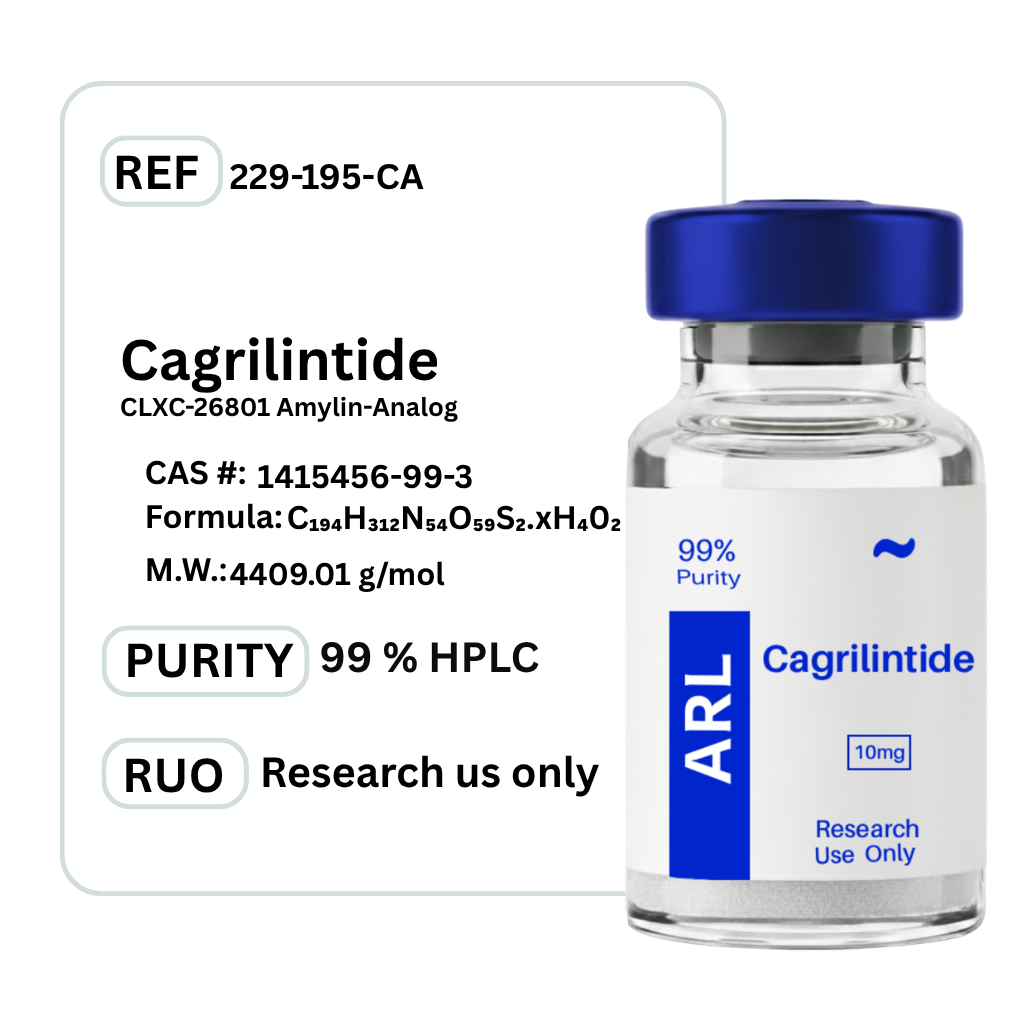
Cagrilintide
Cagrilintide
This batch of Cagrilintide Peptide has been third party lab tested and verified for quality.
Contents: Cagrilintide (Amylin Analogue, Long-Acting Appetite Regulator)
Form: Powder
Purity: 99.3%
Couldn't load pickup availability
Free Reconstitution Solution automatically added to your cart with each order.
This product is Made, Tested & Shipped From Canada.
Ships Today
Order by 1:00 PM EST
Free Shipping
For 2 or more vials
Verified+

Cagrilintide: Comprehensive Investigational Overview for Research Purposes
For Scientific and Regulatory Evaluation—Research Use Only
Executive Summary
This document presents a systematic compilation of published scientific literature regarding Cagrilintide, a synthetic peptide analog of amylin currently under investigation for metabolic research applications. Published research documents potential roles in appetite regulation, satiety enhancement, and metabolic homeostasis maintenance. This compilation is intended exclusively for educational and research purposes.
Regulatory Notice: All information derives from published peer-reviewed scientific literature. No human clinical endpoints are established. Researchers must obtain appropriate institutional oversight prior to conducting investigations.
Cagrilintide Structure
Introduction to Cagrilintide
Cagrilintide constitutes a synthetically engineered acylated peptide developed as an amylin analog—a hormone naturally co-secreted with insulin by pancreatic beta cells. Published literature documents that Cagrilintide is under investigation for regulating appetite sensation, promoting satiety signals, and supporting metabolic equilibrium through interactions with amylin receptors in brain regions governing feeding behavior and energy homeostasis.
Published scientific investigations examine whether Cagrilintide administration reduces metabolic energy acquisition by modulating neural circuits controlling meal magnitude, food reward responses, and gastric emptying. Controlled metabolic studies also investigate its role in body weight modulation and energy balance.
Amylin Physiology and Natural Mechanisms
Published literature identifies amylin, also designated islet amyloid polypeptide (IAPP), as a peptide hormone naturally secreted alongside insulin from pancreatic beta cells. Scientific research establishes amylin as a critical neural signaling molecule promoting satiation sensation. Published investigations document that amylin originates as an 89 amino acid propeptide, produced at approximately 100-fold greater quantities relative to concurrent insulin secretion, subsequently undergoing proteolytic processing to generate its 37 amino acid active form.
Published research documents amylin's multiple physiological functions: decelerating gastric contents progression, enhancing satiation sensation, and attenuating postprandial glucose elevation. Published studies indicate that amylin's delay of post-nutrient glucose increase facilitates superior carbohydrate metabolism regulation.
Published literature further documents amylin's participation in skeletal mineral metabolism and its structural and functional homology with calcitonin and calcitonin gene-related peptide (CGRP). Published research characterizes these related peptides as facilitating calcium equilibrium through promoting mineral skeletal uptake and reducing circulating calcium concentrations. Published investigations suggest amylin influences renal calcium handling, though clinical significance remains under investigation.
Cagrilintide Development: Pharmaceutical Enhancement
Published literature describes Cagrilintide as a synthetically engineered amylin analog engineered with enhanced protease resistance, resulting in substantially extended pharmacological half-life. Published research identifies pramlintide—developed in the early 2000s—as the preceding amylin analog. Published studies document pramlintide effectiveness in reducing postprandial glucose elevation in diabetic individuals through adjunctive insulin therapy. Published literature identifies prolonged pharmacological duration as the primary distinction between Cagrilintide and pramlintide.
Published research documents that enhanced protease resistance addresses native amylin's propensity to accumulate into insoluble protein fibrils. Published investigations indicate that fibril formation occurs when circulating amylin concentration elevates excessively, culminating in amyloid fibril deposition impairing peptide function. Published literature associates these fibrillar deposits with pancreatic beta-cell toxicity and type 2 diabetes disease progression.
Published research proposes that excessive nutrient consumption precipitates simultaneous insulin and amylin discharge, elevating circulating amylin concentration and facilitating fibril accumulation. Published studies note that pathogenic amylin aggregates demonstrate structural parallels with amyloid-beta polymers implicated in neurodegenerative disease pathophysiology.
Receptor Activity-Modifying Proteins: Published Evidence
Published literature describes receptor activity-modifying proteins (RAMPs) as molecular entities associating with G-protein-coupled receptors (GPCRs) to modulate functional properties. Published research indicates RAMP-1 and RAMP-3 interaction with receptors including calcitonin-like, calcitonin, and calcium-sensing receptors, with RAMP-3 additionally associating with secretin receptor. Published literature notes that despite incomplete mechanistic comprehension of numerous RAMP-GPCR interaction physiological consequences, RAMP signaling abnormalities have correlated with cardiovascular disorders, glucose metabolism dysfunction, and neoplastic processes.
Cagrilintide Mechanisms of Action: Published Research
Published investigations document that Cagrilintide functions through multiple integrated mechanisms. Published research indicates that within the gastrointestinal system, Cagrilintide decelerates food passage velocity through gastric and intestinal segments. Published studies document that this deceleration provokes gastrointestinal neural signals to the central nervous system communicating satiation sensation, thereby reducing appetite drive and cumulative nutrient intake.
Published research documents that Cagrilintide exerts direct effects upon the central nervous system. Published animal studies demonstrate substantial amylin receptor populations throughout the arcuate hypothalamic nucleus. Published investigations indicate that Cagrilintide binding to these receptors modulates brainstem and pituitary populations, augmenting satiation signaling.
Published literature documents that Cagrilintide affects pancreatic function analogously to endogenous amylin, participating in regulatory mechanisms suppressing glucagon discharge.
Synergistic Effects with Other Metabolic Agents
Published research documents synergistic interactions between Cagrilintide-induced amylin signaling and glucagon-like peptide-1 (GLP-1) and associated incretin pathway mechanisms. Published investigations indicate these coordinated mechanisms collectively contribute to improved glucose homeostasis and reduced adipose tissue accumulation.
Published studies suggest that concurrent Cagrilintide and semaglutide (a GLP-1 receptor agonist) administration may generate enhanced weight reduction effects compared to either agent alone.
Research Status and Future Directions
Published research indicates Cagrilintide remains under active investigation for metabolic research applications. Published literature suggests early findings indicate Cagrilintide may produce more pronounced weight reduction compared to established GLP-1 receptor agonists. Published investigations also explore potential broader therapeutic applications including cardiovascular health and neurodegenerative disease mitigation.
Bioavailability and Research Specifications
Published literature documents that Cagrilintide is engineered with enhanced protease resistance, resulting in extended pharmacological availability compared to native amylin. Published research supports its use in metabolic research applications.
Research Compilation
Dr. Jens J. Holst, M.D., Ph.D., compiled this comprehensive literature review. Dr. Holst is internationally recognized as a prominent physiologist and endocrinologist with pioneering research contributions regarding gut-derived hormonal mediators including GLP-1, GIP, and amylin analogs.
-
check_circle
HIGHEST QUALITY PEPTIDES
Our products are scientifically formulated and manufactured in cGMP-compliant facilities.
-
encrypted
FAST DELIVERY
Enjoy fast and reliable 3–5 day shipping.
-
check_circle
Dedicated Customer Service
Our customer service team is highly knowledgeable in peptide research and its applications. We’re available 24/7 to assist you.
Verified reviews
Tested. Verified. Trusted.
We take a laboratory-first approach to quality. Each batch is made under controlled conditions and verified by an independent lab (HPLC/MS). We only ship batches that test ≥99% purity, and we provide a full COA, including identity, methods, and chromatograms, for your review.
You may also like
-
Ipamorelin Growth Hormone Peptide - Research Grade Peptide
Regular price From $32.00Regular price From $32.00 Sale priceUnit price / per$42.0023% -
SAVE 25%Reconstitution Solution
Regular price $15.00Regular price $15.00 Sale priceUnit price / per$20.0025% -
Sermorelin - Premium Research Peptide
Regular price From $70.00Regular price From $70.00 Sale priceUnit price / per$92.0023% -
SAVE 25%Gonadorelin
Regular price $50.00Regular price $50.00 Sale priceUnit price / per$67.0025% -
SAVE 23%SLU-PP-332
Regular price $125.00Regular price $125.00 Sale priceUnit price / per$164.0023% -
SAVE 25%Tirzepatide
Regular price From $50.00Regular price From $50.00 Sale priceUnit price / per$67.0025% -
SAVE 23%Semaglutide
Regular price From $36.00Regular price From $36.00 Sale priceUnit price / per$47.0023% -
SAVE 23%CJC-1295 No DAC & Ipamorelin
Regular price $95.00Regular price $95.00 Sale priceUnit price / per$124.0023% -
SAVE 23%5-Amino-1MQ
Regular price $80.00Regular price $80.00 Sale priceUnit price / per$105.0023% -
SAVE 23%BPC-157 + TB-500 + GHK-Cu
Regular price $155.00Regular price $155.00 Sale priceUnit price / per$202.0023% -
SAVE 23%L-Carnitine
Regular price $97.00Regular price $97.00 Sale priceUnit price / per$127.0023% -
CJC-1295 (No DAC) - Premium Research Peptide
Regular price From $75.00Regular price From $75.00 Sale priceUnit price / per$98.0023% -
SAVE 23%Kisspeptin-10
Regular price From $65.00Regular price From $65.00 Sale priceUnit price / per$85.0023% -
SAVE 23%CJC-1295 with DAC
Regular price $139.00Regular price $139.00 Sale priceUnit price / per$182.0023% -
SAVE 24%KPV Tripeptide
Regular price From $56.00Regular price From $56.00 Sale priceUnit price / per$74.0024% -
SAVE 24%Thymosin Alpha-1
Regular price From $79.00Regular price From $79.00 Sale priceUnit price / per$104.0024% -
SAVE 25%Epitalon (Epithalon)
Regular price From $50.00Regular price From $50.00 Sale priceUnit price / per$67.0025% -
Ipamorelin - Premium Research Peptide
Regular price From $32.00Regular price From $32.00 Sale priceUnit price / per$42.0023% -
SAVE 23%Tesamorelin
Regular price From $80.00Regular price From $80.00 Sale priceUnit price / per$105.0023% -
SAVE 23%GHRP-6 - Premium Research Peptide
Regular price From $29.00Regular price From $29.00 Sale priceUnit price / per$38.0023% -
SAVE 25%Melanotan II (MT2)
Regular price $50.00Regular price $50.00 Sale priceUnit price / per$67.0025% -
SAVE 23%Retatrutide Triple Agonist
Regular price From $90.00Regular price From $90.00 Sale priceUnit price / per$118.0023% -
SAVE 24%IGF-1 LR3 (Long R3)
Regular price From $40.00Regular price From $40.00 Sale priceUnit price / per$53.0024% -
SAVE 23%BPC-157 + TB-500
Regular price From $97.00Regular price From $97.00 Sale priceUnit price / per$127.0023% -
SAVE 24%Dermorphin
Regular price $56.00Regular price $56.00 Sale priceUnit price / per$74.0024% -
SAVE 23%Glutathione
Regular price $83.00Regular price $83.00 Sale priceUnit price / per$109.0023% -
SAVE 24%Hyaluronic Acid
Regular price $28.00Regular price $28.00 Sale priceUnit price / per$37.0024%
Every vial we sell comes from a lab that follows current Good Manufacturing Practices (cGMP). That means each step of production is documented and controlled. Before a batch is released, it’s tested by independent third-party labs for purity, identity, and sterility. Certificates of analysis are available so you can see the exact test results.
Yes. The labs we work with use ISO-certified clean rooms where air quality, equipment, and handling procedures are tightly regulated. Staff are trained to pharmaceutical-grade standards. This ensures the peptides are produced in an environment that minimizes contamination risks.
Peptides in lyophilized (freeze-dried) form are stable at room temperature for transport. Once you receive them, refrigeration is recommended to maintain long-term integrity. We package every order securely to prevent damage and ship promptly, so your vials arrive in optimal condition.
We operate under strict in-house protocols that follow current Good Manufacturing Practices (cGMP). That means our team oversees the entire process from sourcing raw amino acids to the final lyophilized vial. Nothing is outsourced or repackaged. This gives us full control over purity, consistency, and sterility, and it’s why we can stand behind every single vial we ship.
Store them in the refrigerator, away from direct light and heat. If you need to keep them longer, some peptides can be stored frozen. Each vial comes with clear handling instructions so you know the proper conditions for stability.
The strongest proof is transparency. For every peptide, we can provide certificates of analysis, manufacturing documentation, and references to the published scientific research behind it. If you ever have questions, we’ll show you the data rather than ask you to take our word for it.
The difference is transparency. Most sites give you a product name and a price. We provide full batch testing, lab documentation, and direct access to certificates of analysis so you don’t have to guess what you’re getting. When you order from us, you know exactly what’s in the vial, where it was made, and how it was verified.