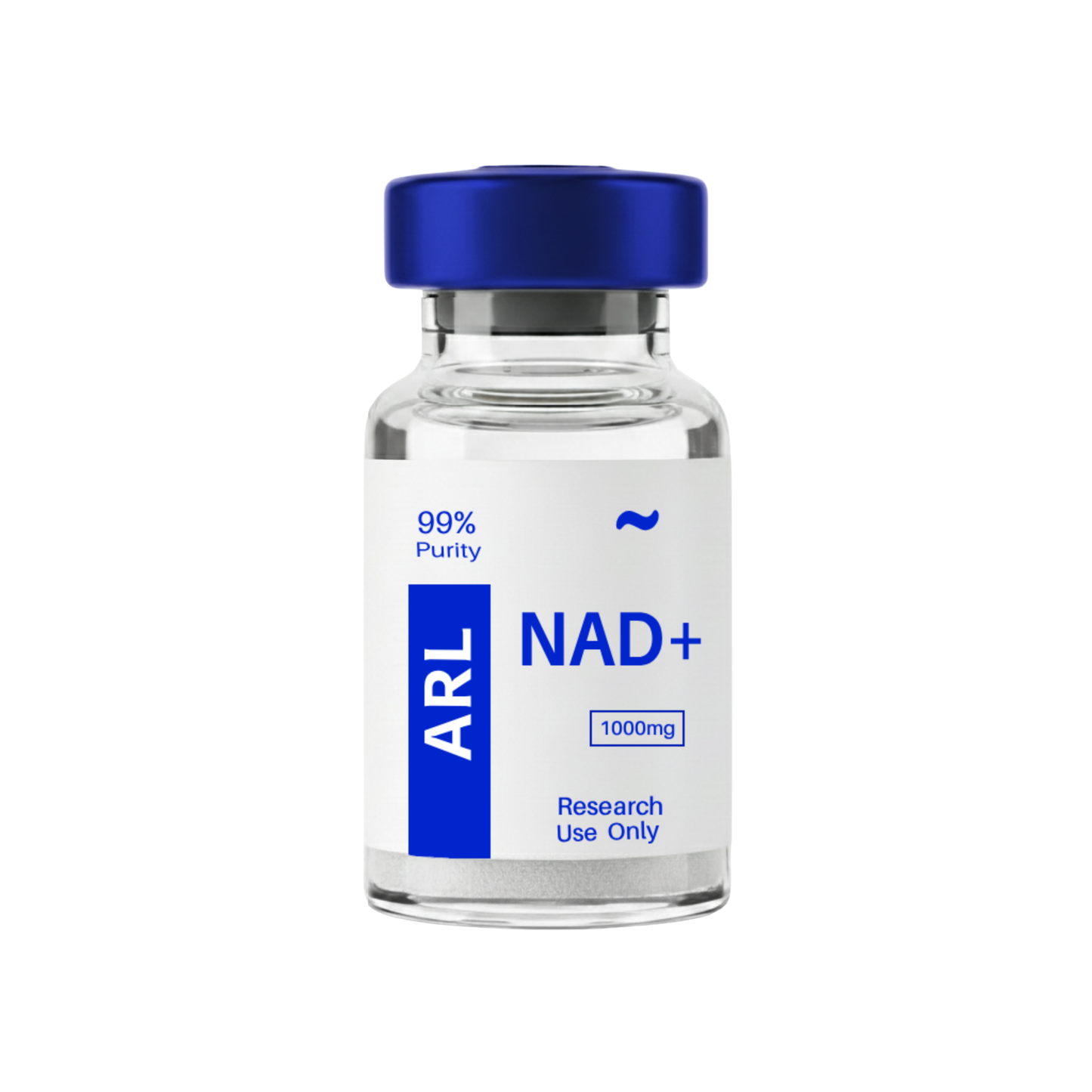
NAD+
NAD+
This batch of NAD+ (Nicotinamide Adenine Dinucleotide) Peptide has been third party lab tested and verified for quality.
Contents: NAD+
Form: Powder
Purity: 99.6%
Couldn't load pickup availability
Free Reconstitution Solution automatically added to your cart with each order.
This product is Made, Tested & Shipped From Canada.
Ships Today
Order by 1:00 PM EST
Free Shipping
For 2 or more vials
Verified+

NAD+ Peptide
NAD+ stands for Nicotinamide Adenine Dinucleotide, an endogenous nucleotide involved in metabolism, cellular energy production, and DNA repair. It Understanding NAD+: The Energy Currency of Cells
NAD⁺ is the shortened name for nicotinamide adenine dinucleotide, and it's the active form of a molecule called NADH. NAD⁺ has one main job: it helps move electrons around in your cells during chemical reactions, which is how cells get and use energy. Energy moves between cells and sometimes even outside of cells. Beyond this energy role, NAD⁺ also helps control how enzymes work, makes changes to proteins after they're made, and helps cells communicate with each other. In some tissues, like blood vessels, the bladder, the colon, and parts of the brain, neurons release NAD⁺ outside the cell where it can send signals.
How NAD+ Works with Different Enzymes
Scientists have learned that Nicotinamide Adenine Dinucleotide (NAD⁺) is essential for helping many different enzymes do their jobs. These enzymes control important processes like energy use, keeping DNA healthy, and allowing cells to talk to each other. Three main groups of enzymes depend on NAD⁺:
Sirtuin Enzymes (SIRTs): These enzymes are like cellular managers. They control which genes turn on or off, manage energy production, and help cells deal with stress. Sirtuins work by removing acetyl groups from proteins, using NAD⁺ to do this. When sirtuins are very active, your body has better energy efficiency, lives longer, and has less damage from harmful molecules called free radicals.
PARP Enzymes (Poly(ADP-ribose) Polymerase): These enzymes are like DNA repair workers. When DNA gets damaged or broken, PARPs find it and use NAD⁺ to make chains that attract repair proteins to the damaged spots. But if there's too much damage, PARPs can use up all the NAD⁺, which hurts the cell's energy and is connected to diseases affecting the brain and metabolism.
cADPRS Enzymes (Cyclic ADP-Ribose Synthetase): These enzymes make a special messenger called cyclic ADP-ribose that controls calcium inside cells. Calcium is important for muscles to contract, for nerve signals to work, and for hormones to be released. This shows how NAD⁺ indirectly but importantly affects communication inside cells and how the body works.
NAD+ Peptide Structure
What Scientists Have Discovered About NAD+
NAD⁺-Dependent Processes
Recent research has identified many important ways NAD⁺ works in the body to keep cells healthy, manage metabolism, and help cells repair themselves:
Sirtuins (SIRTs): These NAD⁺-using enzymes are vital for keeping mitochondria (the cell's power plants) working well, balancing energy use, and keeping stem cells alive and able to reproduce. Sirtuins also protect against damage from free radicals and help prevent nerve damage, suggesting they may help protect the brain and prevent age-related diseases.
PARP Enzymes (Poly(ADP-ribose) Polymerase): There are 17 different types of PARP enzymes, and they all use NAD⁺ to make chains of ADP-ribose that help find DNA damage and keep chromosomes stable. PARP enzymes start DNA repair pathways that protect cells from toxic damage, but if they're overactive, they can use up NAD⁺ and hurt cell energy.
cADPRS Enzymes (Cyclic ADP-Ribose Synthetases): This group includes enzymes called CD38 and CD157, which are important for how the immune system works. These enzymes break down NAD⁺, and this process affects calcium signaling and may help DNA repair, stem cell growth, and cell division progress normally, connecting NAD⁺ to immune function and cell regeneration.
Since these enzyme systems heavily depend on NAD⁺, when there's too much demand or these pathways are overactive, NAD⁺ can become depleted, which limits cell energy and repair ability. Keeping a good balance between making NAD⁺ and using NAD⁺ is important for getting all the benefits of these cellular systems.
NAD⁺ Helps DNA Repair When Cells Lack Oxygen
When nerve cells are grown in a lab and exposed to conditions without enough oxygen, raising NAD⁺ levels helps repair damaged DNA, helps cells survive, and fixes DNA damage caused by oxidative stress. These benefits happen whether you add NAD⁺ before or after the stress. How this works is that PARP enzymes use NAD⁺ to add ADP-ribose chains (through a process called PARylation), which brings repair proteins to the damaged DNA. However, if there's a lot of DNA damage, PARP gets overactive, quickly uses up all the NAD⁺, and breaks other cellular processes that need NAD⁺. Adding NAD⁺ in these situations can help restore cell energy, fix DNA properly, and keep nerve cells alive.
NAD⁺ Protects the Liver and Kidneys
Studies in animal models show that raising NAD⁺ in the blood provides many protective benefits to organs. In obese animals and animals with liver damage from alcohol, increasing NAD⁺ helped control blood sugar better, improved how mitochondria work, and improved overall liver health. In old kidney cells, NAD⁺ made sirtuins work better and stopped a harmful swelling caused by steroids, making kidney cells tougher. Also, giving animals NAD⁺ building blocks like nicotinamide mononucleotide (NMN) had similar benefits, reducing harmful oxidative stress and protecting kidneys from damage by the drug cisplatin. These findings show NAD⁺ has broad potential for helping organs repair themselves and keeping metabolism balanced.
NAD⁺ and Muscle Health
In studies with older mice, giving nicotinamide mononucleotide (NMN) for seven days increased ATP production, lowered inflammation, and improved how well mitochondria worked in muscles. These results make sense because NAD⁺ is known to help with cell energy production. During the breakdown of sugar and the citric acid cycle, NAD⁺ takes electrons and becomes NADH, which then gives those electrons to the mitochondria for energy production. This electron transfer powers the process that makes ATP, the energy that muscles need to work and keep going.
NAD⁺ and Heart Health
When NAD⁺ levels are too low, sirtuins don't work well, which causes mitochondria to produce less energy and blood vessels to not work properly, including narrowing of arteries. In animal studies, giving NMN about thirty minutes before a heart attack happened protected the heart, reduced damage, and helped the heart recover. This shows that having enough NAD⁺ is critical for keeping the heart's energy production working well and protecting it from oxygen shortage damage.
Who Wrote This Review
Dr. Shin-Ichiro Imai, M.D., Ph.D., wrote and organized this scientific review.
Dr. Imai is a famous molecular biologist and expert on aging, best known for discovering how NAD⁺ and sirtuins work. He's a Professor at Washington University School of Medicine in St. Louis and has made important discoveries about how NAD⁺ levels and sirtuin activity affect aging, metabolism, and mitochondrial health. His work has helped scientists develop new treatments that raise NAD⁺ to help cells stay healthy and support healthy aging.
Scientists Who Contributed to This Research
Dr. Shin-Ichiro Imai has done extensive research on how NAD⁺ is made and how sirtuins work, showing how important they are for energy, DNA repair, and mitochondrial function. His research, along with work from famous collaborators like Dr. David A. Sinclair, Dr. Nady Braidy, Dr. Charles Brenner, Dr. Eric F. Fang, and Dr. Vilhelm A. Bohr, has greatly advanced our understanding of NAD⁺'s role in protecting the brain, controlling metabolism, and preventing age-related diseases.
Dr. Imai and his collaborators are recognized leaders in NAD⁺ research. This acknowledgment is only meant to recognize their scientific achievements and is not an endorsement of any product. Montreal Peptides Canada has no relationship, partnership, or shared research with Dr. Imai or any other scientists mentioned here.
References and Sources
Schultz, Michael B, and David A Sinclair. "Why NAD(+) Declines during Aging: It's Destroyed." Cell metabolism vol. 23,6 (2016): 965-966. https://www.ncbi.nlm.nih.gov/pmc/articles/PMC5088772/
Braidy N, Liu Y. NAD+ therapy in age-related degenerative disorders: A benefit/risk analysis. Exp Gerontol. 2020 Apr;132:110831. doi: 10.1016/j.exger.2020.110831. https://pubmed.ncbi.nlm.nih.gov/31917996/
Johnson, Sean, and Shin-Ichiro Imai. "NAD+ biosynthesis, aging, and disease." F1000Research vol. 7 132. 1 Feb 2018. https://www.ncbi.nlm.nih.gov/pmc/articles/PMC5795269/
Bieganowski P, Brenner C. Discoveries of nicotinamide riboside as a nutrient and conserved NRK genes establish a Preiss-Handler independent route to NAD+ in fungi and humans. Cell. 2004 May 14;117(4):495-502. https://pubmed.ncbi.nlm.nih.gov/15137942/
Fang, E. F., Lautrup, S., Hou, Y., Demarest, T. G., Croteau, D. L., Mattson, M. P., & Bohr, V. A. (2017). NAD+ in Aging: Molecular Mechanisms and Translational Implications. Trends in molecular medicine, 23(10), 899-916. https://www.ncbi.nlm.nih.gov/pmc/articles/PMC7494058/
Harden, A; Young, WJ (24 October 1906). "The alcoholic ferment of yeast-juice Part II.--The coferment of yeast-juice". Proceedings of the Royal Society of London. Series B, Containing Papers of a Biological Character. 78 (526): 369-375. https://royalsocietypublishing.org/doi/10.1098/rspb.1906.0070
Mills KF, Yoshida S, Stein LR, Grozio A, Kubota S, Sasaki Y, Redpath P, Migaud ME, Apte RS, Uchida K, Yoshino J, Imai SI. Long-Term Administration of Nicotinamide Mononucleotide Mitigates Age-Associated Physiological Decline in Mice. Cell Metab. 2016 Dec 13;24(6):795-806. https://pubmed.ncbi.nlm.nih.gov/28068222/
Long AN, Owens K, Schlappal AE, Kristian T, Fishman PS, Schuh RA. Effect of nicotinamide mononucleotide on brain mitochondrial respiratory deficits in an Alzheimer's disease-relevant murine model. BMC Neurol. 2015 Mar 1;15:19. https://pubmed.ncbi.nlm.nih.gov/25884176/
Safety & Efficacy of Nicotinamide Riboside Supplementation for Improving Physiological Function in Middle-Aged and Older Adults. https://clinicaltrials.gov/ct2/show/NCT02921659
Braidy N, Liu Y. NAD+ therapy in age-related degenerative disorders: A benefit/risk analysis. Exp Gerontol. 2020 Apr;132:110831. https://pubmed.ncbi.nlm.nih.gov/31917996/
Wang S, Xing Z, Vosler PS, Yin H, Li W, Zhang F, Signore AP, Stetler RA, Gao Y, Chen J. Cellular NAD replenishment confers marked neuroprotection against ischemic cell death: role of enhanced DNA repair. Stroke. 2008 Sep;39(9):2587-95. https://pubmed.ncbi.nlm.nih.gov/18617666/
Rajman, Luis et al. "Therapeutic Potential of NAD-Boosting Molecules: The In Vivo Evidence." Cell metabolism vol. 27,3 (2018): 529-547. https://www.ncbi.nlm.nih.gov/pmc/articles/PMC6342515/
Heer C, et al, Coronavirus infection and PARP expression dysregulate the NAD metabolome: An actionable component of innate immunity. Journal of Biological Chemistry. Volume 295, Issue 52, Dec 2020. https://www.jbc.org/article/S0021-9258(17)50676-6/fulltext
Mehmel, Mario et al. "Nicotinamide Riboside-The Current State of Research and Therapeutic Uses." Nutrients vol. 12,6 1616. 31 May. 2020, doi:10.3390/nu12061616 https://www.ncbi.nlm.nih.gov/pmc/articles/PMC7352172/
Leung A, Todorova T, Ando Y, Chang P. Poly(ADP-ribose) regulates post-transcriptional gene regulation in the cytoplasm. RNA Biol. 2012 May;9(5):542-8. doi: 10.4161/rna.19899. Epub 2012 May 1. PMID: 22531498; PMCID: PMC3495734.is also discussed as a secondary messenger in calcium-dependent signaling and as an immunoregulatory component. Researchers describe NAD+ synthesis through de novo pathways from tryptophan and through salvage routes that include tryptophan, nicotinamide, nicotinic acid, nicotinamide riboside, and nicotinamide mononucleotide. Once formed, NAD+ participates in numerous enzymatic reactions and cellular processes that support metabolic activity. Functionally, it acts as a coenzyme in redox reactions and can be converted to NADH, the energy-carrying form of NAD+.
Overview
Researchers have suggested that Nicotinamide Adenine Dinucleotide acts as a coenzyme for three major enzyme classes:
-Deacetylase enzymes in the sirtuin class (SIRTs)
-Poly(ADP-ribose) polymerase (PARP) enzymes
- Cyclic ADP ribose synthetase (cADPRS)
Research suggests the following interactions with NAD+:
- SIRTs may support mitochondrial homeostasis, stem-cell maintenance and regeneration, and may counter neural degeneration.
- PARPs, a family of 17 enzymes, can utilize NAD+ to synthesize poly(ADP-ribose) chains that influence genome stability.
- cADPRS includes CD38 and CD157, key immunologic enzymes that hydrolyze NAD+ and may stimulate stem-cell regeneration and DNA repair, processes relevant to the cell cycle.
Because these enzymes depend on NAD+, researchers note that high demand can compete for available NAD+ and influence bioavailability. Balancing NAD+ supply with its consumption may be important for achieving the intended impact of these pathways.
Chemical Makeup
Molecular Formula: C₂₁H₂₇N₇O₁₄P₂
Molecular Weight: 663.43 g/mol
Other Known Titles: Nicotinamide adenine dinucleotide; β-NAD; Coenzyme I; Diphosphopyridine nucleotide
Research and Clinical Studies
NAD+ Peptide and Productive Aging
Two key intermediates in NAD+ biology are nicotinamide riboside (NR) and nicotinamide mononucleotide (NMN). In a 12-month study, normal-aging mice exposed to NMN showed indications consistent with increased NAD+ synthesis and reported changes such as reduced weight gain, higher energy metabolism, increased physical activity, improved lipid profile, and other physiological effects.
NAD+ Peptide and Neurodegenerative Activity
Mitochondrial dysfunction limits electron transport and ATP synthesis in neurodegenerative settings. A study in aged mice exposed to NMN for 3–12 months evaluated mitochondrial respiration with a fluorescent NMN probe. After exposure, oxygen-consumption rates in neural and brain cells suggested restored mitochondrial function, consistent with rapid use of the compound to generate NAD+.
NAD+ Peptide and DNA Repair After Ischemic Stress
In neural culture models subjected to ischemic stress, reintroducing NAD+ improved DNA base-excision repair activity, cell viability, and oxidative DNA-damage repair whether added before or after stress. Mechanistically, PARP enzymes consume NAD+ to attach ADP-ribose units (PARylation) that recruit and activate DNA-repair proteins. Excess damage can overactivate PARP and deplete NAD+, potentially disrupting other NAD+-dependent processes. Supplying NAD+ in these conditions may offset depletion and support DNA repair and survival.
NAD+ Peptide and the Liver, Kidney
Raising circulating NAD+ levels in experimental mice was associated with protective effects in models of obesity and alcoholic hepatitis and with improvements in glucose homeostasis and overall liver function. In aged kidney cells, NAD+ supplementation favored SIRT activity and showed protective potential against glucocorticoid-induced hypertrophy. In models using NMN (an NAD+ intermediate), benefits were also reported against cisplatin-induced kidney injury.
NAD+ Peptide and Skeletal Function
Seven days of NMN exposure in aged mice was associated with increased ATP production, reduced inflammation, and enhanced mitochondrial performance. These observations are consistent with NAD+ functioning as a redox cofactor in cellular respiration: NAD+ accepts electrons to form NADH during glycolysis and the citric-acid cycle, and NADH donates electrons in the respiratory chain to drive oxidative phosphorylation and ATP generation.
NAD+ Peptide and Cardiac Functions
NAD+ deficiency has been linked to reduced SIRT activity, with potential downstream effects on energy production and aortic constriction. In a mouse model, NMN administered 30 minutes before induced ischemia produced a cardioprotective effect against ischemic injury.
NAD+ peptide is available for research and laboratory purposes only. Please review and adhere to our Terms and
Conditions before ordering.
References:
- Schultz, Michael B, and David A Sinclair. "Why NAD(+) Declines during Aging: It's Destroyed." Cell metabolism vol. 23,6 (2016): 965-966. https://www.ncbi.nlm.nih.gov/pmc/articles/PMC5088772/
- Braidy N, Liu Y. NAD+ therapy in age-related degenerative disorders: A benefit/risk analysis. Exp Gerontol. 2020 Apr;132:110831. doi: 10.1016/j.exger.2020.110831. https://pubmed.ncbi.nlm.nih.gov/31917996/
- Johnson, Sean, and Shin-Ichiro Imai. "NAD + biosynthesis, aging, and disease." F1000Research vol. 7 132. 1 Feb 2018. https://www.ncbi.nlm.nih.gov/pmc/articles/PMC5795269/
- Bieganowski P, Brenner C. Discoveries of nicotinamide riboside as a nutrient and conserved NRK genes establish a Preiss-Handler independent route to NAD+ in fungi and humans. Cell. 2004 May 14;117(4):495-502. https://pubmed.ncbi.nlm.nih.gov/15137942/
- Fang, E. F., Lautrup, S., Hou, Y., Demarest, T. G., Croteau, D. L., Mattson, M. P., & Bohr, V. A. (2017). NAD+ in Aging: Molecular Mechanisms and Translational Implications. Trends in molecular medicine, 23(10), 899–916. https://www.ncbi.nlm.nih.gov/pmc/articles/PMC7494058/
- Harden, A; Young, WJ (24 October 1906). "The alcoholic ferment of yeast-juice Part II.--The coferment of yeast-juice". Proceedings of the Royal Society of London. Series B, Containing Papers of a Biological Character. 78 (526): 369–375. https://royalsocietypublishing.org/doi/10.1098/rspb.1906.0070
- Mills KF, Yoshida S, Stein LR, Grozio A, Kubota S, Sasaki Y, Redpath P, Migaud ME, Apte RS, Uchida K, Yoshino J, Imai SI. Long-Term Administration of Nicotinamide Mononucleotide Mitigates Age-Associated Physiological Decline in Mice. Cell Metab. 2016 Dec 13;24(6):795-806. https://pubmed.ncbi.nlm.nih.gov/28068222/
- Long AN, Owens K, Schlappal AE, Kristian T, Fishman PS, Schuh RA. Effect of nicotinamide mononucleotide on brain mitochondrial respiratory deficits in an Alzheimer's disease-relevant murine model. BMC Neurol. 2015 Mar 1;15:19. https://pubmed.ncbi.nlm.nih.gov/25884176/
- Safety & Efficacy of Nicotinamide Riboside Supplementation for Improving Physiological Function in Middle-Aged and Older Adults. https://clinicaltrials.gov/ct2/show/NCT02921659
- Braidy N, Liu Y. NAD+ therapy in age-related degenerative disorders: A benefit/risk analysis. Exp Gerontol. 2020 Apr;132:110831. https://pubmed.ncbi.nlm.nih.gov/31917996/
- Wang S, Xing Z, Vosler PS, Yin H, Li W, Zhang F, Signore AP, Stetler RA, Gao Y, Chen J. Cellular NAD replenishment confers marked neuroprotection against ischemic cell death: role of enhanced DNA repair. Stroke. 2008 Sep;39(9):2587-95. https://pubmed.ncbi.nlm.nih.gov/18617666/
- Rajman, Luis et al. "Therapeutic Potential of NAD-Boosting Molecules: The In Vivo Evidence." Cell metabolism vol. 27,3 (2018): 529-547. https://www.ncbi.nlm.nih.gov/pmc/articles/PMC6342515/
- Heer C, et al, Coronavirus infection and PARP expression dysregulate the NAD metabolome: An actionable component of innate immunity. Journal of Biological Chemistry. Volume 295, Issue 52, Dec 2020. https://www.jbc.org/article/S0021-9258(17)50676-6/fulltext
- Mehmel, Mario et al. "Nicotinamide Riboside-The Current State of Research and Therapeutic Uses." Nutrients vol. 12,6 1616. 31 May. 2020, doi:10.3390/nu12061616 https://www.ncbi.nlm.nih.gov/pmc/articles/PMC7352172/
- Leung A, Todorova T, Ando Y, Chang P. Poly(ADP-ribose) regulates post-transcriptional gene regulation in the cytoplasm. RNA Biol. 2012 May;9(5):542-8. doi: 10.4161/rna.19899. Epub 2012 May 1. PMID: 22531498; PMCID: PMC3495734.
- Croteau DL, Fang EF, Nilsen H, Bohr VA. NAD+ in DNA repair and mitochondrial maintenance. Cell Cycle. 2017 Mar 19;16(6):491-492. doi: 10.1080/15384101.2017.1285631. Epub 2017 Feb 1. PMID: 28145802; PMCID: PMC5384578.
Dr. Marinov
Dr. Marinov (MD, Ph.D.) is a researcher and chief assistant professor in Preventative Medicine & Public Health. Prior to his professorship, Dr. Marinov practiced preventative, evidence-based medicine with an emphasis on Nutrition and Dietetics. He is widely published in international peer-reviewed scientific journals and specializes in peptide therapy research.
-
check_circle
HIGHEST QUALITY PEPTIDES
Our products are scientifically formulated and manufactured in cGMP-compliant facilities.
-
encrypted
FAST DELIVERY
Enjoy fast and reliable 3–5 day shipping.
-
check_circle
Dedicated Customer Service
Our customer service team is highly knowledgeable in peptide research and its applications. We’re available 24/7 to assist you.
Verified reviews
Tested. Verified. Trusted.
We take a laboratory-first approach to quality. Each batch is made under controlled conditions and verified by an independent lab (HPLC/MS). We only ship batches that test ≥99% purity, and we provide a full COA, including identity, methods, and chromatograms, for your review.
You may also like
-
Ipamorelin Growth Hormone Peptide - Research Grade Peptide
Regular price From $32.00Regular price From $32.00 Sale priceUnit price / per$42.0023% -
SAVE 25%Reconstitution Solution
Regular price $15.00Regular price $15.00 Sale priceUnit price / per$20.0025% -
Sermorelin - Premium Research Peptide
Regular price From $70.00Regular price From $70.00 Sale priceUnit price / per$92.0023% -
SAVE 25%Gonadorelin
Regular price $50.00Regular price $50.00 Sale priceUnit price / per$67.0025% -
SAVE 23%SLU-PP-332
Regular price $125.00Regular price $125.00 Sale priceUnit price / per$164.0023% -
SAVE 25%Tirzepatide
Regular price From $50.00Regular price From $50.00 Sale priceUnit price / per$67.0025% -
SAVE 23%Semaglutide
Regular price From $36.00Regular price From $36.00 Sale priceUnit price / per$47.0023% -
SAVE 23%CJC-1295 No DAC & Ipamorelin
Regular price $95.00Regular price $95.00 Sale priceUnit price / per$124.0023% -
SAVE 23%5-Amino-1MQ
Regular price $80.00Regular price $80.00 Sale priceUnit price / per$105.0023% -
SAVE 23%BPC-157 + TB-500 + GHK-Cu
Regular price $155.00Regular price $155.00 Sale priceUnit price / per$202.0023% -
SAVE 23%L-Carnitine
Regular price $97.00Regular price $97.00 Sale priceUnit price / per$127.0023% -
CJC-1295 (No DAC) - Premium Research Peptide
Regular price From $75.00Regular price From $75.00 Sale priceUnit price / per$98.0023% -
SAVE 23%Kisspeptin-10
Regular price From $65.00Regular price From $65.00 Sale priceUnit price / per$85.0023% -
SAVE 23%CJC-1295 with DAC
Regular price $139.00Regular price $139.00 Sale priceUnit price / per$182.0023% -
SAVE 24%KPV Tripeptide
Regular price From $56.00Regular price From $56.00 Sale priceUnit price / per$74.0024% -
SAVE 24%Thymosin Alpha-1
Regular price From $79.00Regular price From $79.00 Sale priceUnit price / per$104.0024% -
SAVE 25%Epitalon (Epithalon)
Regular price From $50.00Regular price From $50.00 Sale priceUnit price / per$67.0025% -
Ipamorelin - Premium Research Peptide
Regular price From $32.00Regular price From $32.00 Sale priceUnit price / per$42.0023% -
SAVE 23%Tesamorelin
Regular price From $80.00Regular price From $80.00 Sale priceUnit price / per$105.0023% -
SAVE 23%GHRP-6 - Premium Research Peptide
Regular price From $29.00Regular price From $29.00 Sale priceUnit price / per$38.0023% -
SAVE 25%Melanotan II (MT2)
Regular price $50.00Regular price $50.00 Sale priceUnit price / per$67.0025% -
SAVE 23%Retatrutide Triple Agonist
Regular price From $90.00Regular price From $90.00 Sale priceUnit price / per$118.0023% -
SAVE 24%IGF-1 LR3 (Long R3)
Regular price From $40.00Regular price From $40.00 Sale priceUnit price / per$53.0024% -
SAVE 23%BPC-157 + TB-500
Regular price From $97.00Regular price From $97.00 Sale priceUnit price / per$127.0023% -
SAVE 24%Dermorphin
Regular price $56.00Regular price $56.00 Sale priceUnit price / per$74.0024% -
SAVE 23%Glutathione
Regular price $83.00Regular price $83.00 Sale priceUnit price / per$109.0023% -
SAVE 24%Hyaluronic Acid
Regular price $28.00Regular price $28.00 Sale priceUnit price / per$37.0024%
Every vial we sell comes from a lab that follows current Good Manufacturing Practices (cGMP). That means each step of production is documented and controlled. Before a batch is released, it’s tested by independent third-party labs for purity, identity, and sterility. Certificates of analysis are available so you can see the exact test results.
Yes. The labs we work with use ISO-certified clean rooms where air quality, equipment, and handling procedures are tightly regulated. Staff are trained to pharmaceutical-grade standards. This ensures the peptides are produced in an environment that minimizes contamination risks.
Peptides in lyophilized (freeze-dried) form are stable at room temperature for transport. Once you receive them, refrigeration is recommended to maintain long-term integrity. We package every order securely to prevent damage and ship promptly, so your vials arrive in optimal condition.
We operate under strict in-house protocols that follow current Good Manufacturing Practices (cGMP). That means our team oversees the entire process from sourcing raw amino acids to the final lyophilized vial. Nothing is outsourced or repackaged. This gives us full control over purity, consistency, and sterility, and it’s why we can stand behind every single vial we ship.
Store them in the refrigerator, away from direct light and heat. If you need to keep them longer, some peptides can be stored frozen. Each vial comes with clear handling instructions so you know the proper conditions for stability.
The strongest proof is transparency. For every peptide, we can provide certificates of analysis, manufacturing documentation, and references to the published scientific research behind it. If you ever have questions, we’ll show you the data rather than ask you to take our word for it.
The difference is transparency. Most sites give you a product name and a price. We provide full batch testing, lab documentation, and direct access to certificates of analysis so you don’t have to guess what you’re getting. When you order from us, you know exactly what’s in the vial, where it was made, and how it was verified.